

June 2, 2026 Bond Vote Information

Dawson County residents will vote on whether or not to approve a $4,970,000 general obligation bond on June 2, 2026.
Estimated Tax Impact for Residential Properties
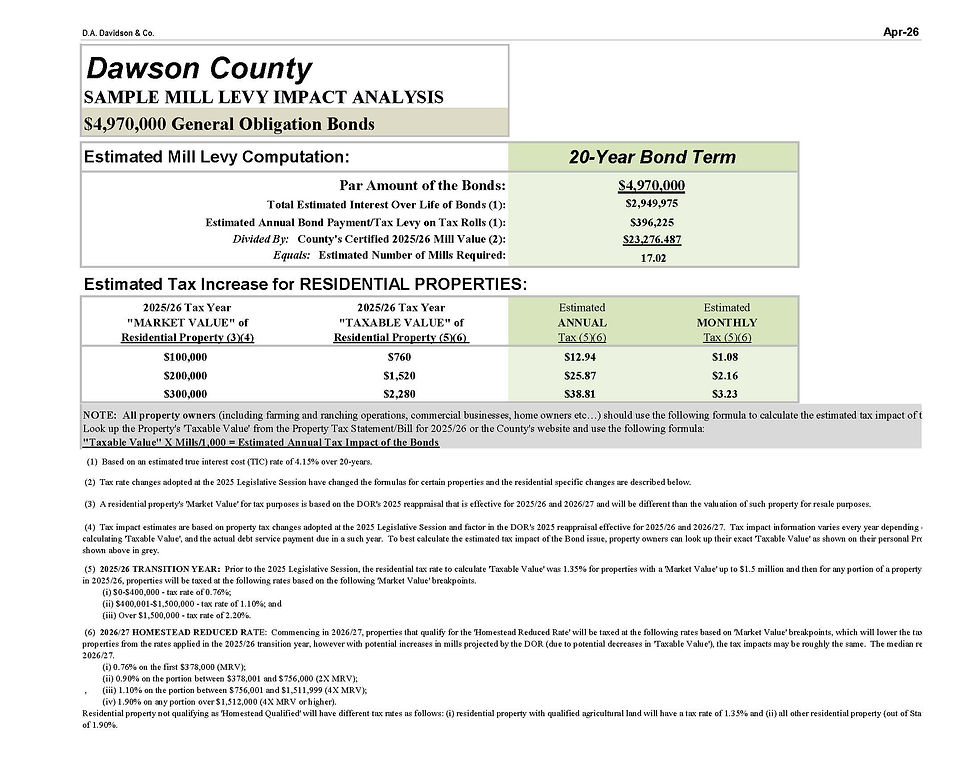
The table below shows the estimated annual and monthly costs of the bond based on the market value of your home.
Estimates provided by D.A. Davidson & Co. (April 2026), based on a 4.15% interest rate over 20 years and the county's certified 2025/26 mill value of $23,276,487. Actual costs may vary.
How to calculate your tax impact
The estimated mill levy is 17.02 mills. To calculate your tax impact, use this formula with your property's taxable value:
Your Taxable Value × 0.01702 (mill levy) = Estimated Annual Tax Increase
Example: A home with a market value of $200,000 and a taxable value of $1,520 would pay approximately $25.87 per year ($1,520 × 0.01702).
-
How to Find Your Taxable Value: Your taxable value appears on your 2025/26 Property Tax Statement or tax bill. If you don't have your statement, contact the Montana Department of Revenue at (406) 377-4256. For additional property information, visit the Dawson County Treasurer's website.
-
A Note on Current Tax Rates: State law recently changed how residential taxable values are calculated. For homes with a market value up to $400,000, the tax rate is now 0.76% (down from the previous rate of 1.35%).
-
Tax Assistance Programs: You may qualify for programs that reduce your property taxes, including assistance for disabled or deceased veterans, the Extended Property Tax Assistance Program, and the Elderly Homeowner's Tax Credit. Contact the Montana Department of Revenue at (406) 377-4256 to learn more.
Frequently Asked Questions
When is the vote and how do I participate?
The bond vote is on Tuesday, June 2, 2026. Absentee ballots will be mailed in May. All eligible Dawson County voters may participate.
For information on voter registration, polling locations, and absentee voting, visit the Dawson County Elections office website.
What is a general obligation bond?
A general obligation bond is a loan taken out by the county and repaid over time through property taxes. Voters must approve it before the county can borrow the money. If approved, the $4,970,000 would be repaid over 20 years, helping to spread out costs over time.
What will the bond money be used for? Can it be used for anything else?
The bond money will be used only (and exactly) for the items described on the ballot. The money cannot legally go into the general fund or be spent elsewhere.
Are there tax assistance programs to help me with the costs?
Yes, Montana has several tax assistance programs to help qualifying residents:
-
Property Tax Assistance Program (PTAP): Helps citizens on a fixed or limited income by reducing the property tax rate on their home. Learn more.
-
Montana Elderly Homeowner/Renter Credit program: Property tax relief program that provides a refundable income tax credit of up to $1,150. Learn more.
What is "taxable value" and how do I calculate it? How much is this going to cost me?
Taxable value is the number the Montana Department of Revenue (DOR) assigns to your property to calculate your property taxes. It is a percentage of your home's market value. For most residential homes with a market value up to $400,000, the current taxable value rate is 0.76%.
To estimate your cost if the bond passes, use this formula:
Your Taxable Value × 0.01702 = Estimated Annual Tax Increase
Your taxable value is listed on your 2025/26 Property Tax Statement. If you don't have your statement, contact the Montana DOR at (406) 377-4256.
I don't live in Glendive. Why am I voting on this project?
Dawson County owns the West Glendive levee. Dawson County and the City of Glendive have partnered with the U.S. Army Corps of Engineers to reduce flood risk, and the Army Corps will cover 65% of the project's cost. The proposed bond would fund the local 35% share.
The levee improvement project has consequences for the entire county and region. According to data analysis and research from the U.S. Army Corps of Engineers, a major flood in West Glendive would damage roads, utilities, and businesses that residents throughout Dawson County depend on, including grocery stores and other essential services. Protecting West Glendive from flooding helps protect the regional economy and the county's tax base.
I live or own a business in the West Glendive floodplain. Will this affect my flood insurance requirements?
Possibly. Properties located in FEMA-designated flood zones are typically required to carry flood insurance if they have a federally backed mortgage. If the levee improvements are completed and certified by FEMA, many homes and businesses in West Glendive that are currently in the high-risk zone could be removed from the regulatory floodplain, which will eliminate mandatory flood insurance requirements for those properties.
Who is overseeing the project? How will we know the money is spent correctly?
The project is being led by the U.S. Army Corps of Engineers, which is responsible for the engineering design and construction. Dawson County and the City of Glendive are the local partners and are accountable to the public for how bond funds are spent.
What happens if the bond does not pass?
If the bond does not pass, the levee improvement project would not move forward at this time. The current levee would remain in place without the planned upgrades. The businesses and residences in West Glendive's floodplain would continue to have flood risk.
The U.S. Army Corps of Engineers has identified this project as its preferred solution, and federal cost-sharing is tied to moving forward with an approved local funding plan. Without local funding in place, that federal partnership — and the cost savings that come with it — may not remain available indefinitely.
Additionally, updated FEMA flood maps are expected to expand the high-risk floodplain regardless of whether the bond passes. That means more properties could face mandatory flood insurance requirements if the levee is not improved.